Guest Feature: The AI credibility question in Loss Prevention at the SCO

In the last 24 months, the label AI has been slapped onto so many products that it has effectively become invisible. From smart socks to AI-enabled toothbrushes, the promise is always the same: this device thinks for you.
For those of us in the retail industry, this creates a dangerous noise-to-signal ratio. When vendors pitch AI-powered solutions, the instinct is to treat it with the same scepticism we reserve for an AI-powered toaster. Is it real innovation, or is it just a slightly better algorithm with a higher price tag? This scepticism is healthy. It forces us to demand definitions. And for Loss Prevention, the only definition that matters is this: Does the AI enable action in the physical world, in real time? If the answer is yes, you’re talking about Computer Vision – about Physical AI.
Unlike the smart appliances filling consumer shelves, Physical AI is not a gimmick. It is the digitisation of physical space that enables real action as events unfold. It doesn’t rely on probability or guesswork: it relies on vectors and geometry to create a living Digital Twin of the store – a continuous understanding of where products are, where people are moving, and how they’re interacting with products.
This matters because the power of AI in retail isn’t just in analysing what happened. It’s in the ability to impact the physical world while it’s happening. Loss Prevention has become the proving ground for this infrastructure because the value of real-time calculation is so clear: the faster insights reach the people who can act on them, the more effective the response becomes.
Physical AI and real-world complexity
To understand why this isn’t just the equivalent of an AI-powered toaster, let’s consider what’s actually required to detect concealed theft at self-checkout using existing store cameras. The system must track a person from aisle to checkout – often across sparse, inconsistently placed CCTV feeds with no calibrated 3D space, variable angles, and low resolution.
We know that the lab is not the store. In the real world, systems face distinct hurdles: occlusion, peak-hour crowds, and visual ambiguities. The challenge lies in creating technology that accommodates the messiness of human behaviour – for example shoppers who put products back or abandon baskets halfway through the journey. This complexity is why most systems underperform – not because they can’t detect anything, but because they can’t distinguish what matters from what doesn’t.
When too many alarms divert attention
It’s peak hour at a grocery store and the self-checkout line is long. A couple of interventions and an age verification trigger simultaneously, and the associate clears them without much of an upward glance. When every alert carries the same weight, none of them carry any weight at all.
This is where physical AI becomes a key differentiator. The question isn’t just can the system detect issues – but whether it can be tuned to surface the issues that matter most to the operation. Aligning detection sensitivity with store policies, product priorities, and intervention capacity is what turns raw alerts into actionable intelligence.
Theft outside the checkout area remains invisible
But here’s where most SCO monitoring hits a wall that no amount of configuration can fix. If someone conceals a product in aisle 7 and walks calmly to self-checkout, a system monitoring only the till has no idea that item ever existed. You cannot generate an alert for something you never saw. No amount of policy tuning fixes a blind spot that fundamental.
When Trigo analysed over 600 documented theft incidents with a retail partner, the data revealed something that most SCO monitoring systems are architecturally incapable of detecting. While losses occurred at manned lanes and via customers walking straight out the exit, 76 per cent of incidents were concentrated at self-checkout. That much wasn’t surprising. What was surprising – and significant – was how those thefts occurred. For high-value product categories, concealment was the method used almost every time. Not missed scans. Not barcode swaps. Items that never reached the scanner at all because they had been hidden long before the customer approached the till.
Tracking the full customer journey
Addressing this requires tracking the full shopping journey – from shelf to checkout – so the system understands not just what happened at the register but what led up to it. Trigo’s physical AI was originally built for autonomous checkout, where every product interaction must be tracked with precision. That same full-journey intelligence now applies to loss prevention, using a retailer’s existing CCTV infrastructure.
Because the system tracks products – not just transactions – it knows what was concealed, not merely that something went unscanned. This contextual understanding of the store floor is what makes differentiated alerts possible. An interaction with a premium spirits item should not trigger the same response as a low-value impulse product.
Product oriented and smarter interventions
Trigo allows retailers the flexibility to configure alert policies, with tailored response levels based on different risk factors – so that a concealment in a high-value aisle prompts a stronger intervention, while a lower-priority incident doesn’t need to interrupt the associate mid-task.
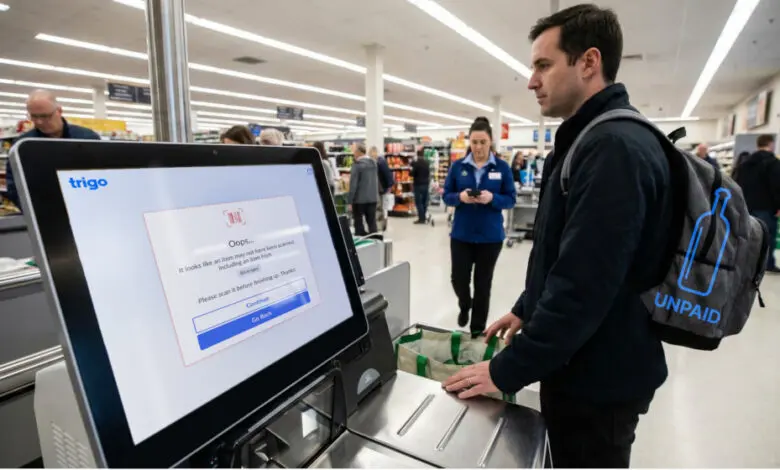
In practice, this means tiered responses at the checkout itself. A low-priority alert might simply prompt the shopper with a pop-up that an item wasn’t scanned – but they can proceed and pay as normal. A medium-priority alert pauses the transaction with an option to self-correct or call an associate. A high-priority alert – triggered, for example, by concealment of a frequently stolen high-value item – requires a full stop and associate intervention. The shopper experience scales with the risk, and associates only get pulled in when it matters. This brings us back to alert fatigue. The problem isn’t alert volume alone – it’s alert meaning. When you know the severity of the alert, you can align the response to the actual risk. When you only know something flagged, every alert carries equal weight, which means none of them do.
Pilot in two weeks – using existing cameras
At this point, the reasonable question is: what does it take to find out if this works for a specific retail company? The assumption many retailers carry is that deploying AI means significant upfront investment – new cameras, complex integrations, months of implementation before you see any data. That assumption is outdated.
Trigo’s system was designed to work with existing CCTV infrastructure. This means there’s no need for new hardware, camera repositioning, or a lengthy IT project. New cameras are only needed if none currently monitor the areas of interest – which is rare. The system works with an existing setup, the addition of a workstation, and requires no store downtime or remodelling.
Making data visible that current systems overlook
To activate a pilot, Trigo integrates with the CCTV feed. SCO integration is optimal for real-time alerts but optional – a faster offline approach uses a CSV export of receipts with scanning times and sometimes a product catalogue is also needed to validate detection accuracy before any live integration. This means retail employees can start seeing data on what their current systems are missing without touching their checkout infrastructure.
In most cases, a pilot can be operational within two weeks – and implementation speed increases after the first store, making rollout progressively faster.
Testing the system
You don’t have to trust the claims. You can test the system. This changes the nature of the decision. You’re not being asked to trust a vendor’s claims or commit to a multi-year transformation. You’re being offered the chance to measure – quickly and with minimal disruption – whether full-journey, product-aware detection actually reduces shrink in your environment, with your customers, under your operating conditions.
The investment required to answer that question is low. The cost of not asking it – continued blind spots, alert fatigue, and loss that walks out the door undetected – is already on your P&L.
Why not find out?
See Physical AI in action at EuroShop.