Guest Feature: Why tomorrow’s retail needs a different kind of network


Most retailers are planning for a future that will look very different from the one they operate in today. Stores are becoming more digital, more data-driven and more interconnected. Operations are increasingly supported by automation, real-time decision making and new forms of customer interaction. And behind the scenes, the technology landscape is expanding in both scale and complexity.
This shift isn’t driven by a single innovation. It’s the cumulative effect of multiple trends accelerating at the same time. The growth of IoT. The rise of AI. The demand for hyper-personalised experiences. Tighter security expectations. Leaner in-country IT teams. More centralised governance. Faster deployment cycles.
For retailers preparing for this next chapter, the question is no longer: “What does our network support today?” It’s: “What will our network need to support tomorrow, and how do we prepare for that now?”
The shifting shape of retail workloads
Tomorrow’s retail environment requires a different kind of network. Not simply an upgraded version of what already exists, but an architecture designed for a new operational reality.
The network is becoming a critical backbone for retail operations, not just a transport layer. As digital systems multiply, the variety and volume of workloads they generate changes the demands placed on infrastructure. Understanding these emerging patterns is the first step in preparing for the future.
AI and intelligent automation
AI is moving from the edge of retail operations into the centre. From forecasting and workforce planning to real-time decisioning, vision systems and task automation, AI workloads will increasingly be distributed between cloud and store environments. They depend on predictable performance, secure routing, and sufficient headroom to handle periods of intense processing.
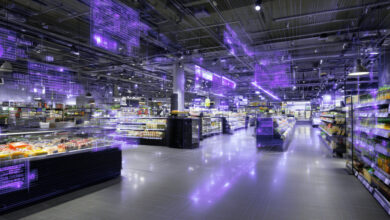
Modern stores contain hundreds of connected devices: handhelds, sensors, digital price labels, HVAC controls, CCTV, robotics, refrigeration monitoring and more. Each generates traffic, requires secure onboarding and contributes to the overall load on the network.
Dense device estates
This is not a theoretical future; it is a visible trend today. The number of connected endpoints per store is rising year on year, and networks need to be designed with this acceleration in mind.
Retail operations increasingly depend on fast, accurate information sharing. Whether it is restocking decisions, temperature alerts, out-of-stock notifications or dynamic pricing updates, the difference between seconds and minutes can have meaningful business impact. A network designed around batch data movement will struggle in a world of continuous flows.
In-store digital experiences
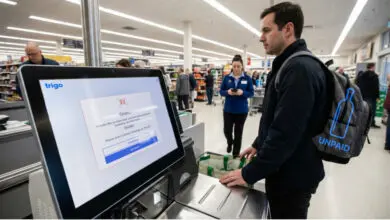
Customer-facing technologies – digital displays, kiosks, interactive screens, product guides – are becoming more embedded in stores. Their performance directly affects customer perception. As these experiences become richer, the network must support consistent, smooth delivery. This is increasingly critical as many retailers see higher volumes of card and cashless transactions, reducing tolerance for any disruption at store level. According to the European Central Bank, electronic payments continue to grow across Europe, reinforcing expectations that store systems are always available and responsive.
An ECB consumer payments study covering the euro area shows that card payments account for 45 per cent of physical retail transactions, while cash has declined to 38 per cent, confirming a structural shift toward cashless payments across Western Europe.
PCI increasingly assume always-on payments
This shift is also reflected in how payment security is evolving. Frameworks such as PCI DSS 4.0 increasingly assume always-on payments, distributed store estates and continuous monitoring rather than periodic checks. For retail IT teams, this reinforces a simple truth: network availability, security and compliance are shaped by the same design decisions.
Many retailers still operate networks built around yesterday’s assumptions: predictable traffic, fixed architectures and limited diversity of devices. These models can become strained when exposed to modern workloads.
Several issues commonly appear:
- Inflexibility during change
Traditional networks often rely on rigid configurations and manual updates. Introducing new technologies or scaling workloads can require significant effort and long lead times, slowing down transformation initiatives.
- Limited visibility
When networks span multiple countries and carriers, it becomes difficult for central IT teams to diagnose issues quickly or gain clear insight into performance. This lack of transparency affects decision-making and slows down incident response.
- Inconsistent security posture
Different markets often evolve different security controls over time. This creates uneven risk and makes it harder to apply unified policies, especially when adding AI systems with sensitive data.
- Bottlenecks created by legacy architecture
Older networks aren’t built for distributed intelligence or edge processing. As more processing happens in store, outdated architectures can become bottlenecks.
Networks designed for yesterday’s retail simply weren’t built to handle the complexity, dynamism and workload diversity that tomorrow will bring. Many retail networks still reflect an older way of thinking. Designs often begin with hardware choices, bandwidth calculations or legacy constraints rather than with a clear understanding of what the business needs the network to enable.
Teams enabling business instead of managing networks
As retail environments become more complex, this approach becomes harder to sustain. Networks grow heavier, harder to manage and slower to adapt. Instead of quietly supporting operations, they start demanding attention. Teams spend time managing infrastructure rather than enabling the business. A principle that increasingly resonates with retail IT leaders captures this shift well: the network should serve the purpose, not be the purpose.
In a modern retail environment, the network exists to enable outcomes. It should support secure transactions, real time data flows, automation, visibility and resilience without becoming a focal point. When the network is designed around intent rather than components, complexity reduces and value increases.
In a modern retail environment, the network exists to enable outcomes. It should support secure transactions, real time data flows, automation, visibility and resilience without becoming a focal point. When the network is designed around intent rather than components, complexity reduces and value increases.
Faster store readiness
This mindset encourages IT teams to step back from individual technologies and focus instead on what the organisation is trying to achieve. Faster store readiness. Consistent security. Predictable performance. The ability to introduce new digital services without reengineering the estate each time.
When the network fades into the background, retail teams can focus on what really matters: operating efficiently, responding quickly to change and delivering a reliable experience across every store.
The shift toward intentional, outcome-based design
Forward-looking retailers are approaching network transformation not as a refresh, but as an opportunity to rethink how the network should behave in a modern retail environment. The question becomes: what outcomes must the network support, and how should it be designed to achieve them?
Three principles are emerging:
- Design for consistency, not uniformity
Consistency means central teams can set policy, monitor performance and maintain security across all stores.
It doesn’t mean forcing identical carriers, equipment or processes in every country.
A network designed for consistency gives retailers confidence that new capabilities can scale without unexpected variation.
- Build flexibility into the architecture
A future-ready network should adapt to workload changes with minimal friction. SD-WAN plays a major role here, enabling dynamic routing, centralised management and a more agile response to operational demands.
Flexibility is also cultural – it requires suppliers, partners and internal teams who work in simple, predictable ways and understand local market realities.
- Engineer for resilience, not perfection
Retail networks operate in the real world – construction delays, weather events, local council approvals, carrier outages and unexpected dependencies are part of the environment.
Resilience comes from designing with these scenarios in mind:
- Alternative access paths
- Clear processes for local exceptions
- Robust monitoring
- Simple models for disaster recovery
- Architectures that degrade gracefully, not catastrophically
A resilient network is one that enables stores to operate confidently, even when conditions are less than ideal.
Centralisation changes the way networks must be managed
As more retailers consolidate IT leadership into central hubs, the responsibilities of the network shift. Central teams are expected to govern more, support more and standardise more – often with the same or fewer resources.
This creates pressure to remove complexity wherever possible.
A network designed for tomorrow must:
- Provide reliable, accurate data to central teams
- Reduce operational noise
- Simplify troubleshooting
- Allow non-specialists in local markets to maintain basic responsibilities
- Support shared accountability between central and in-country teams
When the network is standardised and centrally visible, centralisation delivers its intended benefits: stability, scalability and speed.
A partner model that reflects modern retail
Modern retail networks demand an operating model that bridges the gap between central vision and local execution. This requires partners who:
- Understand multi-country regulatory and operational differences
- Work in a structured, dependable way
- Communicate with clarity
- Take ownership of local actions while supporting central governance
- Operate with professional humility – prioritising reliability over theatrics
The partner landscape is evolving. Retailers increasingly look for suppliers who feel like an extension of their own teams: culturally aligned, technically competent and capable of maintaining high standards across diverse markets.
Preparing now for what comes next
The network a retailer builds today will shape its ability to innovate tomorrow. Decisions about architecture, operating models and standardisation will influence everything from deployment timelines to security posture and customer experience.
By designing for consistency, flexibility and resilience, retailers can create networks capable of supporting:
- The next wave of AI
- Real-time store operations
- Increasing device density
- More centralised IT organisations
- Growing cybersecurity demands
Tomorrow’s retail environment will be more digital, more distributed and more demanding. Networks must evolve accordingly.A future-ready network isn’t defined by what boxes it uses.
It’s defined by how well it supports the retailer’s ability to grow, adapt and operate with confidence.