Vusion repositions itself as enabler of AI-native stores

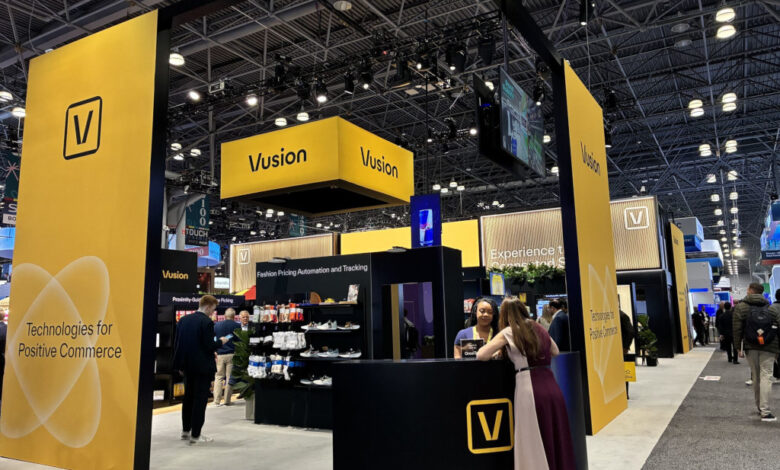
Last week, at NRF’s Big Show in New York City, VusionGroup presented itself under a new name for the first time. From now on, it will simply be called Vusion. With the renaming, the specialist for the digitalisation of physical retail outlets wants to herald a new era: instead of just implementing the ‘Connected Store’ as before, Vusion now wants to enable retailers to create the ‘AI-native Store’.
The starting point for the AI initiative of the Paris-based retail technology provider with French and Austrian roots is the AI enablement of its EdgeSense platform, which the company unveiled in October last year. Its main purpose is to bring one thing to the processes in retail outlets: the use of insights from data in real time.
EdgeSense is essentially the digital shelf system that Walmart is introducing in North America and dm Drogeriemarkt in Europe. Unlike traditional electronic shelf labels (ESLs), it enables precise geolocation and direct, product-related communication with other devices such as smartphones in the hands of retail employees or customers. With the EdgeSense technology, the individual labels are powered by a rechargeable battery in the shelf rail, so they no longer need (one-way) batteries themselves.
New dimension spatial intelligence
By opening up the EdgeSense platform that controls this hardware to AI applications, Vusion now wants to enable the EdgeSense rails already installed at companies such as Walmart and dm to be used for real-time spatial intelligence. A real-world example in retail outlets is the use of digital glasses that highlight products suitable for the user’s specific consumption habits, which they supposed to pick for shoppers’ online orders or which are placed incorrectly.
“By combining 3D positioning, computer vision and natural language models, EdgeSense AI enables physical environments to recognise, interpret and dynamically respond to people and products – heralding a new era of sensor-integrated, GenAI-powered retail,” explains Andreas Rössl, Group CTO of Vusion.
Real-time operational implementation
While connected stores primarily collect data and provide it with a delay, AI-native stores are designed to interpret this information in real time and translate it directly into operational decisions. To achieve this, Vusion combines AI and data functions with an open cloud platform and intelligent IoT devices. The aim is to continuously optimise in-store processes – from pricing and shelf availability to staff support and customer interaction.
In future, decisions will no longer be delayed or made manually but will be based directly on contextual data from the store. “Retail is entering its AI-native and intelligent age,” says Thierry Gadou, CEO of Vusion: “Vusion empowers retailers, employees, brand manufacturers and shoppers, revolutionising how stores operate, how decisions are made and how shopping experiences are created.”
Spatial data layer creates efficiency
The new spatial data layer enables applications that go beyond traditional store analytics. For the first time, AI systems receive precise information about where products, customers and employees are located and what is happening in their environment. For example, customers can ask for a product and not only be guided to the right shelf but also receive additional contextual information such as offers or recipe suggestions. Employees also benefit from precise navigation, task prioritisation and better decision support.
“EdgeSense AI intelligently interconnects the physical world,” says Roy Horgan, SEVP Strategy, Marketing and Communications at Vusion: “For years, AI lived in the cloud. Today, it is becoming spatial, tangible and present, enabling it to understand the context of every interaction in the market.”