Family Mart Japan installs hybrid checkouts from Toshiba

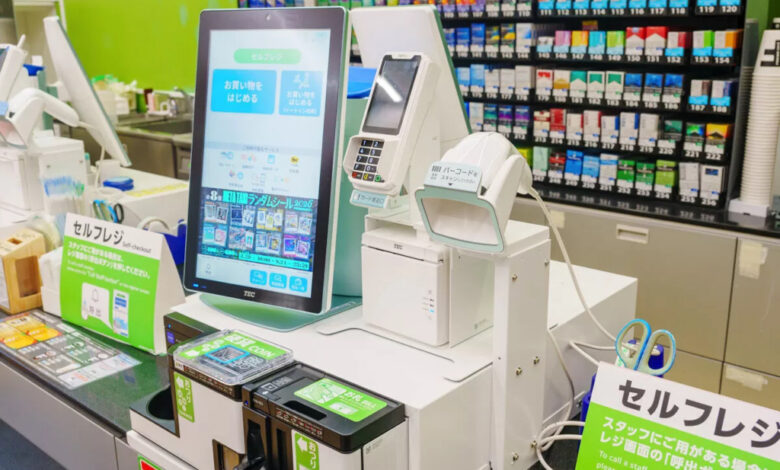
Japanese convenience retailer Family Mart has started rolling out new POS systems across its approximately 16,500 stores in Japan. Toshiba is supplying the CV-330 POS system, which the retailer can use flexibly as either a staffed till or a self-checkout. NEC is supplying the new payment system and connecting the payment terminal to its Multi-Service Gateway payment platform. The system supports around 40 services for electronic payments, credit cards, and QR and barcode payments.
Toshiba has standardised the hardware, software and user interface for both operating modes. This enables Family Mart to utilise the same POS hardware in different ways depending on staffing levels and customer footfall. The stores therefore do not require separate systems for manned checkouts and self-checkouts.
Family Mart is a Japanese convenience retail company based in Tokyo that operates through a franchise system. At the end of August 2026, its retail network comprised 16,455 stores in Japan and 9,191 overseas. The roll-out, which has now begun, covers the approximately 16,500 Japanese stores.
Family Mart switches checkout modes flexibly
During peak times, staff can use the CV-330 as a manned till. This also applies to processes and products where staff intervention is required. Family Mart cites parcel collection, bill payments and the sale of hot snacks as examples, amongst others.
During quieter periods and at night, the stores can switch the same system to self-checkout mode. This allows customers to pay independently, whilst staff attend to other tasks. Family Mart also aims to reduce queuing times at the tills through this flexible operation.
New interface simplifies operation
The modular hardware can be adapted to different store layouts. Toshiba has eliminated the physical keyboard and instead incorporated a 15.6-inch touchscreen display. The system combines a barcode scanner, a receipt printer, a payment terminal and, optionally, an automatic cash module. A unified user interface featuring icons, animations and on-screen prompts makes it easier for new staff to get started.
Buttons positioned low down are designed to make the system more accessible to children and people in wheelchairs. Family Mart is planning further accessibility features such as displays in Hiragana and English, as well as spoken instructions. At the self-checkout, customers will in future also be able to purchase discounted products and top up their e-wallets. A call function connects them to a member of staff if required.
Family Mart expects a 20 per cent reduction in staff costs
With the new till system, automatic cash modules and payment terminals, Family Mart aims to reduce the daily workload at the till by 20 per cent. Staff are to use the time saved for other tasks in the store. Furthermore, the company aims to reduce the total daily working hours in its stores by around 20 per cent by the 2030 financial year compared with 2025, through a range of automation measures.
Family Mart has also announced the ‘Task-Building’ model, which calculates staffing requirements based on expected customer numbers. The company intends to link the calculated working hours to the existing Famima Work system. The software will then suggest suitable shifts and create work schedules for specific times of the day.